…
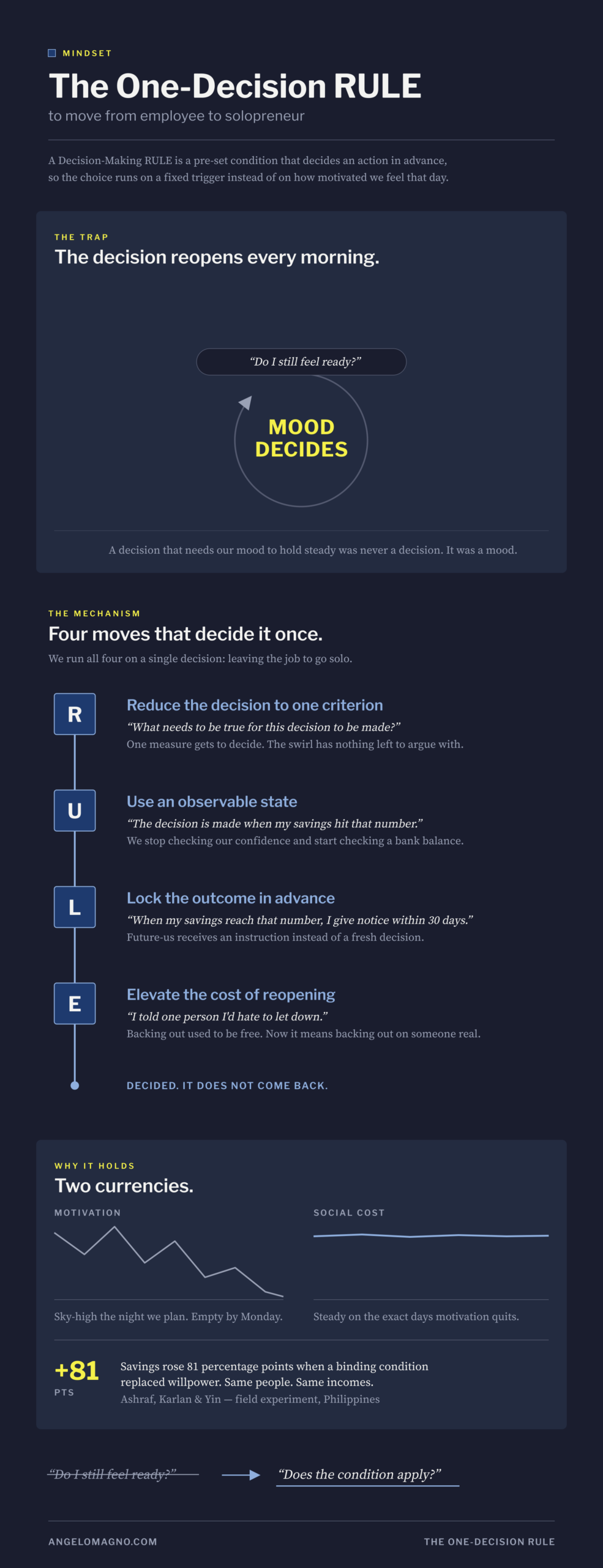
A Decision-Making RULE is a pre-set condition that decides an action in advance, so a choice runs on a fixed trigger instead of on how motivated you feel that day. It links one action to one observable state, then raises the cost of backing out. Once it is set, you check the condition and move.
It’s the one thing standing between the job we keep meaning to leave and the business we keep meaning to start.
That move from employee to solopreneur?
It almost never stalls on a bad plan. It stalls because we never close the decision to go, so we circle the same call for months and tell ourselves we’re getting ready.
Moving from employee to solopreneur doesn’t fail from a bad plan. It fails from a decision we keep reopening.
This is the deep-dive version of a simple idea:
We can turn “should I go solo?” into a Decision-Making RULE, a single condition that decides for us, so the call holds up on the tired Monday when we don’t feel like it.
We’ll walk one decision the entire way, quitting the job to go solo, and we’ll bring in the research and the doubts as we go, because a rule we don’t trust is a rule we won’t run.
Here’s what we’re covering:
- Why the decision won’t close
- The RULE, built step by step
- Pressure-testing the RULE
- The mental model to keep
Why won’t the decision just close?
Let’s start with the thing we tell ourselves, because it sounds so reasonable.
“I haven’t started my business yet because I need more certainty. Once I know the business will work, the call makes itself.”
There’s a quiet assumption buried in there, right? That the decision is waiting on facts.
Most of the time, though, it’s waiting on us. On tomorrow-me waking up and still agreeing with today-me.
The open decision isn’t waiting on proof. It’s waiting on our mood.
And a decision that needs our mood to hold steady was never a decision, was it? It was a mood.
And moods, well, they expire.
Quitting feels obvious the night we map the whole business, and thin by the Monday we were supposed to hand in notice.
It stops being “do I still feel ready to start?” and turns into something with more teeth: “what would have to be true for this decision to hold on the days we don’t feel like it?”
That question is the doorway. Let’s walk through it.
The RULE: making the call once, so we stop remaking it
A Decision-Making RULE is a binding condition that turns a choice into an automatic action.
The decision lives as a fixed instruction instead of a daily debate. It survives the tired, doubtful version of us, because that version doesn’t get asked how it feels. It reads the condition and moves.
RULE: Reduce, Use, Lock, Elevate. Four moves that decide the leap once.
The name is the shape of it. Reduce, Use, Lock, Elevate, and we’re going to run all four on the same decision, leaving the job to go solo, so we can watch it turn from a mood into a mechanism.
R — Reduce the decision to one criterion
Here’s the first move, and it’s the one that fights everything our brain wants to do.
We take the swirl and crush it down to one measure that gets to decide.
That feels wrong at first, doesn’t it? A decision that big should require a big, layered, spreadsheet-heavy answer.
But that instinct is the trap, and there’s a well-known bit of research that shows why.
Barry Schwartz laid it out in his book The Paradox of Choice, and he framed the whole problem like this:
“Learning to choose is hard. Learning to choose well is harder. And learning to choose well in a world of unlimited possibilities is harder still.”
Read that again, because that’s the exact spot we’re standing in. Building our own thing is a world of unlimited possibilities, and we’re in it trying to choose well.
And the more options we hold open, the worse it gets.
Psychologists Sheena Iyengar and Mark Lepper ran the study everyone quotes:
A jam table in a fancy store, six jams on some days, twenty-four on others. At the big table, three percent of the people who stopped bought something. At the small one, 30 percent did.
More choice pulled a bigger crowd and left almost nobody able to decide.
More options pulled the crowd in, and left almost nobody able to choose.
So we Reduce. Instead of “am I ready to start?”, which is a feeling that moves every day, we pick the one thing the whole call can rest on: ”what needs to be true for this decision be made?” One criterion. Now our 2 a.m. doubts have nothing left to argue with.
U — Use an observable state
This is where we make it something we can just look at, no interpreting required.
We sit down, add up a year of expenses, and land on an actual number. Then the criterion becomes a state we can observe: “the decision is made when my savings hit that number.”
That’s the move. We’re not checking our confidence anymore, we’re checking a bank balance.
We stop checking our confidence and start checking if the observable state is true.
An objective status we can point at takes away all the wiggle room our feelings love so much. And once we’ve got the number, we lock what it triggers.
L — Lock the outcome in advance
Here’s something we should expect in every high-stakes journey: doubt!
We’ve felt sure before, haven’t we?
Sure on a Sunday, gone by Wednesday. So this time we decide the action now, while our head is clear, and we write it down before the doubt shows up: “when my savings reach that number, I give notice within 30 days.”
No renegotiating at the line.
We’re handing future-us an instruction instead of a fresh decision, because we already know future-us can’t be trusted to feel ready.
Kind of freeing, in a way, to stop waiting on a feeling that was never coming.
E — Elevate the cost of reopening it
Let’s be honest: we could do R, U, and L, feel great about it, and still back out on a bad Monday when no one’s watching.
We’ve done that exact thing before. So we plan for the backing-out.
We make it public.
We tell one person we’d hate to let down. Out loud: “when my savings hit this number, I’m giving notice within 30 days to start my business.” And something shifts, doesn’t it?
Backing out used to be free. Now it means backing out on someone real.
Think about the two currencies we’re dealing with.
- Motivation is all over the place, sky-high the night we plan, gone by the Monday we’re wiped.
- Social cost holds its value on the exact bad days when motivation has already left the room.
Motivation is a currency that crashes. Social cost keeps its value on the hard days.
And the research on this is hard to shrug off.
In a field experiment in the Philippines, economists Nava Ashraf, Dean Karlan, and Wesley Yin gave bank clients a savings account that locked the money away until they hit a goal they’d set for themselves. Nothing else, just the lock.
The people who took it grew their savings by around 81 percentage points over a control group in a single year.
Same people. Same incomes. The only new thing was a binding condition, and it did the work that willpower couldn’t.
That’s the whole shift we’re going for. We stop leaning on discipline and start leaning on a condition we set once, when we were clear.
So that’s the RULE, end to end, on one decision.
- Reduce it to runway.
- Use the number in the account.
- Lock the notice to the number.
- Elevate the cost by telling someone.
Doubt and fear can still show up after that, sure. They just show up with their vote already gone.
Pressure-testing the RULE
Now, if you’re anything like me, you didn’t just nod along to all that.
Somewhere around step two your brain started poking holes, right?
Good. Let’s poke them together, out loud, because a rule that can’t survive our own objections has no shot at a hard Monday.
If the RULE can’t survive our own doubts, it won’t survive a bad Monday.
Isn’t it reckless to shrink a huge life decision down to a single criterion?
And, yeah, I get the reflex.
But sit with it for a second, because complexity was never the thing killing us here. Endless reconsideration was.
At some point the whole tangle has to collapse into one thing that gets to decide, or the decision just never closes.
We can choose that one criterion with care. We just can’t skip choosing it.
What about new information? What if something changes after I lock it?
There’s always more information.
If our decision needs the complete picture before it moves, we’ve signed up to stand still forever.
So we draw a line:
- New information only counts if it moves the number we tied the decision to.
This feels unrealistic. People don’t run on cold logic like this.
Right. That’s the whole point.
The RULE doesn’t ask us to have superhuman discipline, because we don’t.
It leans on pre-commitment instead, the same thing we already trust everywhere else in life:
- Contracts.
- Deadlines.
- Exams.
We’re terrible at keeping promises to ourselves and pretty reliable with conditions we’ve bound ourselves to in advance.
What if I pick the wrong criterion?
Then the mistake happens once, and that’s the upgrade.
A rule built on a shaky criterion still beats an open decision, because the flaw is sitting right there in the open where we can see it and fix it.
A wrong criterion gets corrected. An unclosed decision just mutates month after month, wearing that “being responsible” costume while it drains us dry.
A wrong criterion fails once. An open decision fails on a loop, forever.
Notice what happened there, though. None of those objections broke the rule, did they? Each one just showed us, from a different angle, why a binding condition does the work our willpower keeps failing to do.
The mental model to keep
So let’s zoom out, because underneath all of it there’s something pretty simple.
To move from employee to solopreneur is sitting hostage to our morning mood, waiting on a version of us that happens to feel ready.
And that version, if we’re honest, is shaky by design.
Building a whole business on whether we feel it on a given Tuesday, that’s the real gamble. Not the rule. The mood.
The leap isn’t blocked by the world. It’s held hostage to our mood.
So the fix was never a bigger push, was it?
It’s one condition that takes our mood out of the vote. The RULE ends the daily negotiation.
It swaps:
- “do I still feel ready?”
for:
- “does the condition apply?”
One of those we lose on hard days. The other one just holds, no drama, while we go build.
So, look at the decision we keep circling, the one to leave and go solo.
If moving forward needs us to feel ready first, then what we’re holding isn’t a plan at all. It’s a negotiation wearing the mask of one.
So we run the RULE on it.
Reduce it to a criterion. Use a state we can watch. Lock the action to that state. Elevate the cost of walking away.
We don’t need a stronger will, you know?
We just need to stop handing the tired version of us a vote.
Inforgraphic
FAQ
What is a Decision-Making RULE?
A Decision-Making RULE is a pre-set condition that links one action to one observable trigger and settles it in advance. You check whether the condition is met and act, instead of re-choosing based on how motivated you feel. It holds through doubt and flat days, since the action fires on the trigger rather than on how sure you happen to be.
What does RULE stand for?
RULE is an acronym for the four moves that close a decision: Reduce it to one criterion, Use an observable state as the trigger, Lock the action in advance, and Elevate the cost of reopening it. Each step pulls the choice further from your daily mood, so the decision holds even when your motivation doesn’t.
Is reducing a complex decision to one criterion too simplistic?
It’s simple on purpose, and that’s the mechanism at work. Complexity isn’t the enemy; endless reconsideration is. At some point a choice has to collapse into one measure that gets to decide, or it never survives contact with time. You pick that criterion with care, then commit to it, so the decision can close for good.
What if new information shows up after I set the RULE?
New information counts when it moves the observable state you tied the decision to. If it shifts your trigger, you update the RULE to match. If it leaves that trigger untouched, it’s noise dressed as diligence. Hold that boundary and you keep moving, instead of treating every stray fact as a reason to reopen the whole thing.
How is a Decision-Making RULE different from a goal?
A goal names what you want; the RULE names what triggers the action. “Go solo this year” is a goal, and it waits on motivation. “When my savings hit this number, I give notice within 30 days” is a RULE, and it fires on a condition you can observe. The RULE closes the daily vote a goal leaves open.